
Every carpet buyer eventually has to answer this question, and the honest answer is not the one the romance of the trade suggests. Hand-knotted rugs are extraordinary objects. They are also slow, expensive, inconsistent by nature and entirely unsuited to most commercial requirements. Machine-made carpets solve a different problem. Knowing which problem you are solving is what makes the decision easy.
How the Two Are Actually Made
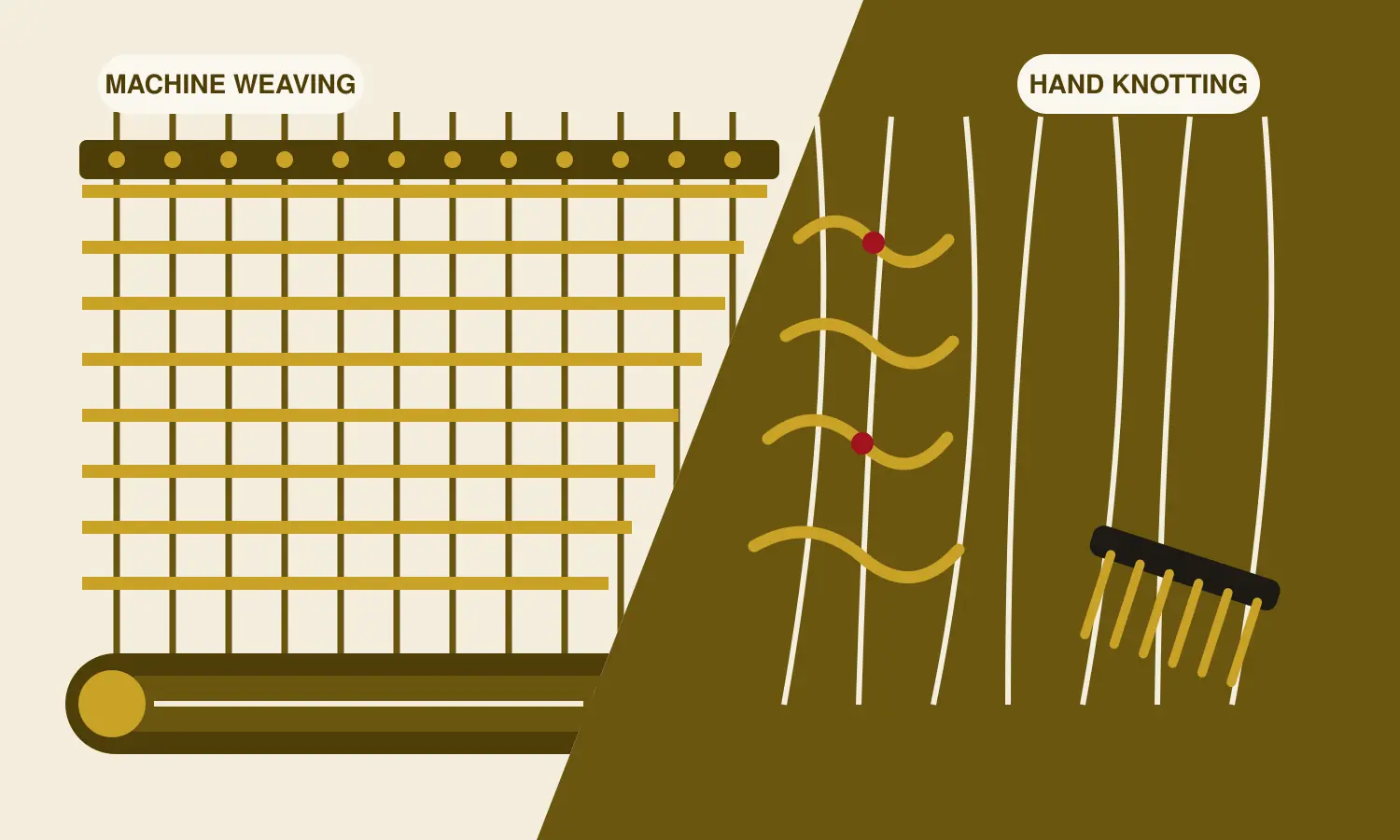
A hand-knotted rug is built knot by knot on a vertical loom. A weaver ties each tuft of yarn around paired warp threads, packs the row down with a beater, and repeats — tens of thousands of times per square metre. A single large rug can occupy one or more weavers for months.
A machine-made carpet is woven on a power loom, most often a face-to-face Wilton loom controlled by a jacquard head that reads the design file. Two backings are woven simultaneously with pile yarn passing between them; a blade splits the sandwich down the middle, producing two finished carpets at once. A loom can produce in an hour what a hand weaver produces in weeks.
Hand-tufted rugs sit between the two: yarn is punched into a stretched backing with a hand-held tufting gun, then secured with latex and a secondary backing. They are faster than knotting but depend on adhesive, which limits their working life.
The Comparison That Matters
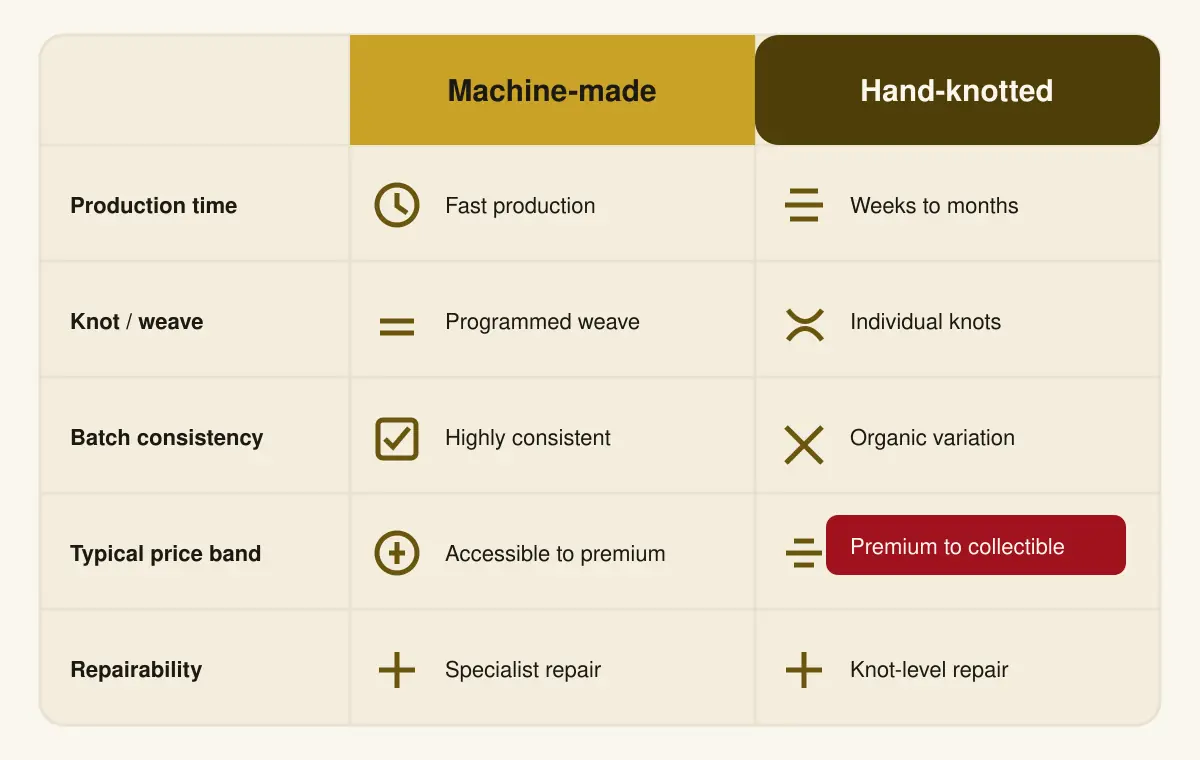
- Production time. Machine-made: hours per piece, with repeat orders delivered in weeks. Hand-knotted: months per piece, and a repeat order is effectively a new commission.
- Consistency. Machine-made pieces from one run are identical. Hand-knotted rugs vary in size, tension and shade — part of their appeal, and a serious problem if you need forty matching units.
- Price band. The gap is not incremental. Hand-knotted pricing reflects months of skilled labour; machine-made pricing reflects minutes of machine time.
- Design flexibility. A new machine-made design needs a jacquard file and a sample run. Changing a hand-knotted design means retraining weavers on a new cartoon.
- Repairability. A hand-knotted rug can be reknotted and restored almost indefinitely. A machine-made carpet is generally replaced rather than repaired.
- Appreciation. Fine antique hand-knotted rugs can hold or gain value. Machine-made carpets are consumer goods and depreciate like any other.
How to Tell Them Apart
Three checks settle it in under a minute:
- Turn it over. A hand-knotted rug shows the pattern on the back with the same clarity as the front, and the knots are visibly irregular. A machine-made carpet shows a uniform grid and usually a visible backing material.
- Look at the fringe. On a hand-knotted rug the fringe is the warp — it is structural, the rug is literally built on it. On most machine-made carpets the fringe is sewn or woven on as a finish and can be removed without the carpet falling apart.
- Check the edges. Hand-knotted selvedges are wrapped by hand and slightly uneven. Machine-made edges are overlocked with machine regularity.
None of these checks is a verdict on quality. They identify the construction, nothing more. A well-engineered machine-made carpet outperforms a poorly made hand-knotted rug on every practical measure.
Choosing for Your Market
Choose machine-made when
- You need volume, repeatability and a predictable delivery date.
- You are fitting out multiple rooms, floors or properties to one specification.
- Your customer wants a specific look at an accessible price point.
- The floor will take heavy traffic and will eventually be replaced rather than restored.
- You need a defined range of sizes and colourways to merchandise against.
Choose hand-knotted when
- The rug is a single statement piece and the client is buying its provenance.
- Your market values the irregularity and the story of hand production.
- The piece is intended to be kept, repaired and inherited.
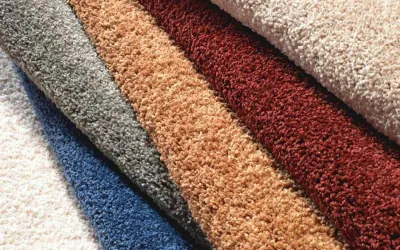
Most of our export customers run both. Hand-knotted goods anchor the top of the range and establish credibility; machine-made collections such as Double Shrink, Persian and Chenille carry the turnover.
Where Machine-Made Has Genuinely Closed the Gap
The quality argument against machine-made carpets is thirty years out of date. Modern jacquard looms handle very high colour counts, and finishing processes have transformed the surface. Heat-shrink treatments produce sculpted relief that reads as hand-carving. Chenille and lustre yarns give the sheen once associated with silk. Antique-wash and abrash effects reproduce the tonal variation of aged handmade rugs convincingly enough that the difference is a trade question rather than a consumer one.
What machine production cannot replicate is the specific irregularity of a human hand — and for a large part of the market, that was never what the customer was buying.
Frequently Asked Questions
Do machine-made carpets last?
A well-specified machine-made carpet in a domestic setting typically gives many years of service. Lifespan is driven by fibre, pile density and traffic rather than by the loom, which is why pile weight per square metre is worth more attention than any marketing claim.
Are hand-knotted rugs always better quality?
No. Quality depends on materials, knot density and workmanship. A loosely knotted rug in weak yarn will fail long before a dense, well-finished machine-made carpet.
Can a machine-made carpet be made in a custom size?
Yes, within the loom width. Custom lengths, bespoke colourways and private-label designs are routine for wholesale orders; the practical constraints are minimum quantity and the setup cost of a new jacquard file.
Getting a Specification You Can Rely On
Whichever construction you choose, buy on documented specification rather than description. Ask for fibre content, pile height, total weight per square metre, backing type, colourfastness data and the available size range — then confirm it against a physical sample.
Melikhan Carpets manufactures machine-made carpets and rugs in Gaziantep and exports worldwide. Contact our team to discuss specifications, samples and wholesale terms.